
|
| Pearson 10M Electric Drive |
|
After six years I have logged about 8000 miles and 1800 hrs sailing my boat. 20 to 25% of that motoring. I have made short trips with overnights, towed other boats, punched through nasty entrance waves, and more, but it's mostly in and out of harbor for daysailing. My dock is about 2 miles up a river from open water. I typically motor out and sail part of the way back in. Motoring time is on the order of 45 to 60 min total every time I go out. On the passages I have done I have mostly sailed or motorsailed with only a few having significant parts with just motoring (more than 5 or 6 miles). I have made some changes to the system along the way and there are things I might have done differently with what I have learned so far.
My electric drive performs better than the diesel did in every way except range. It's more powerful, quieter, smoother, less maintenance, always ready, better at slow speed, and lighter (by about 200 lbs). |
|
BATTERY 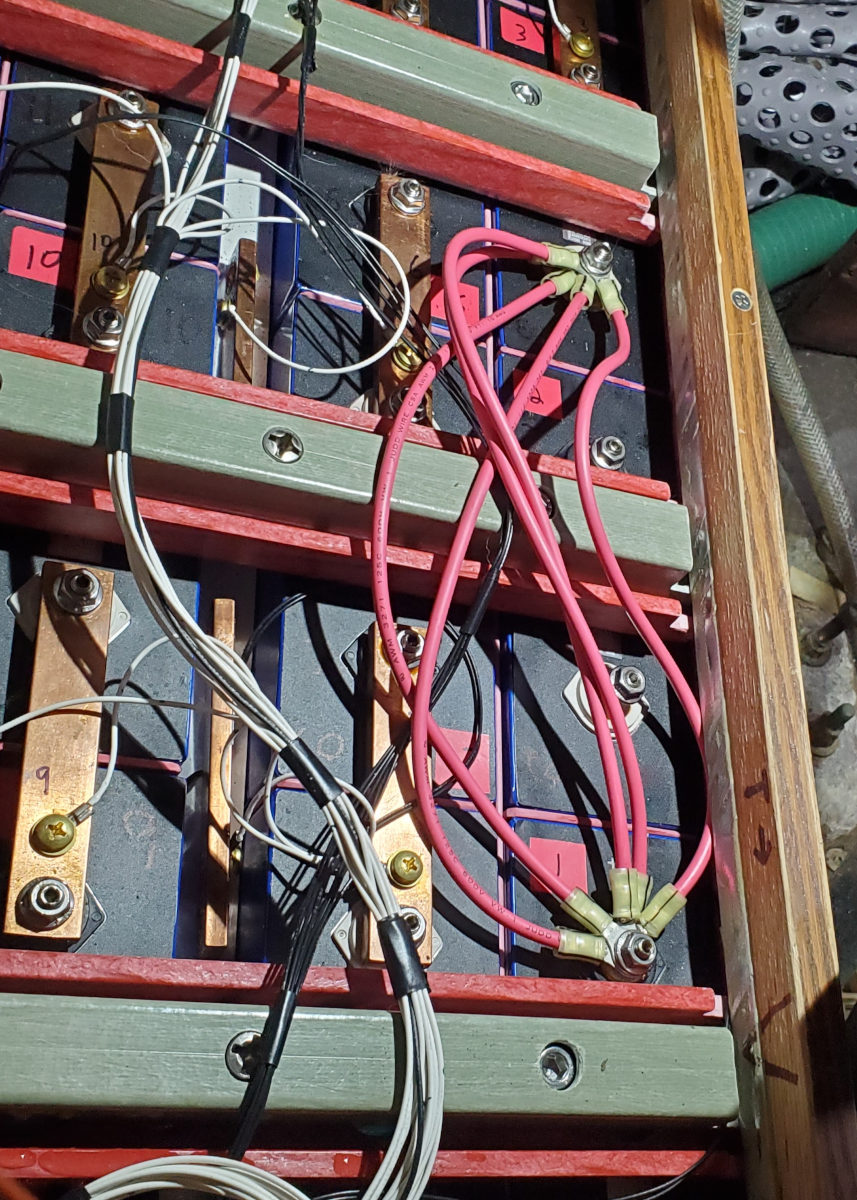 After 4 years I had one cell in my battery go bad. I noticed it when the pack voltage dropped from 54 to 51 at the end of the winter storage. I tested all the cells with a voltmeter and founds one was not showing voltage. I made up a set of jumpers and bypassed that cell and was able to operate the motor without any issues to move the boat in and out of my dock.
I was able to replace the one bad cell with a new cell and all has been fine since. The replacement cell was slightly taller and I had to modify the bus bars and shim the cell hold-down clamps to fit it. |
|
BATTERY CASE 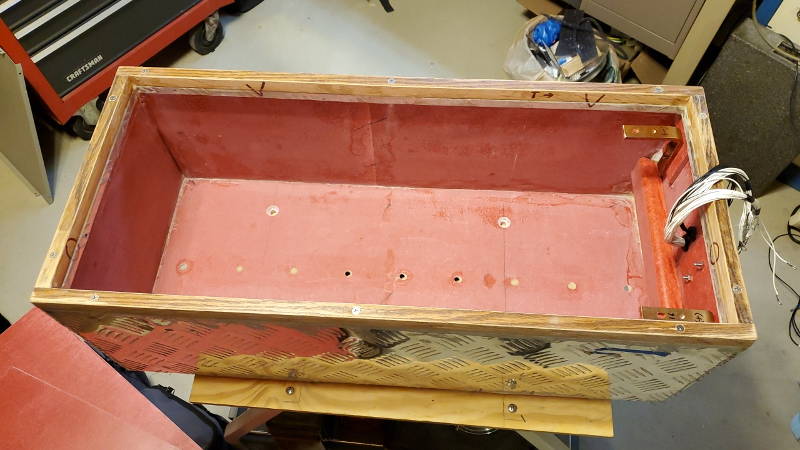
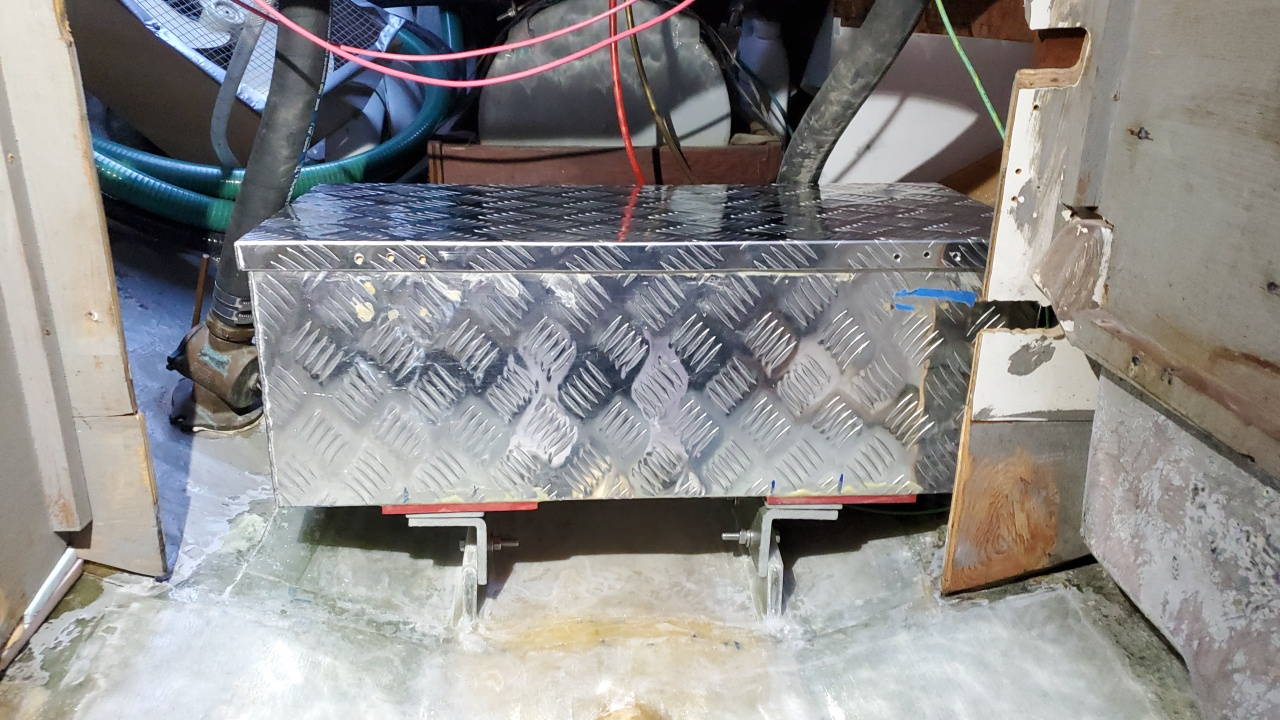 I built my battery case from an aluminum box. It was intended to be a tool box. I lined it with fiberglass sheet. I built it because at the time (2021) I could not find suitable cases made for a 48V battery using the cells I got. There are several available now and today I might just go with one of those rather than what I built.
|
BMS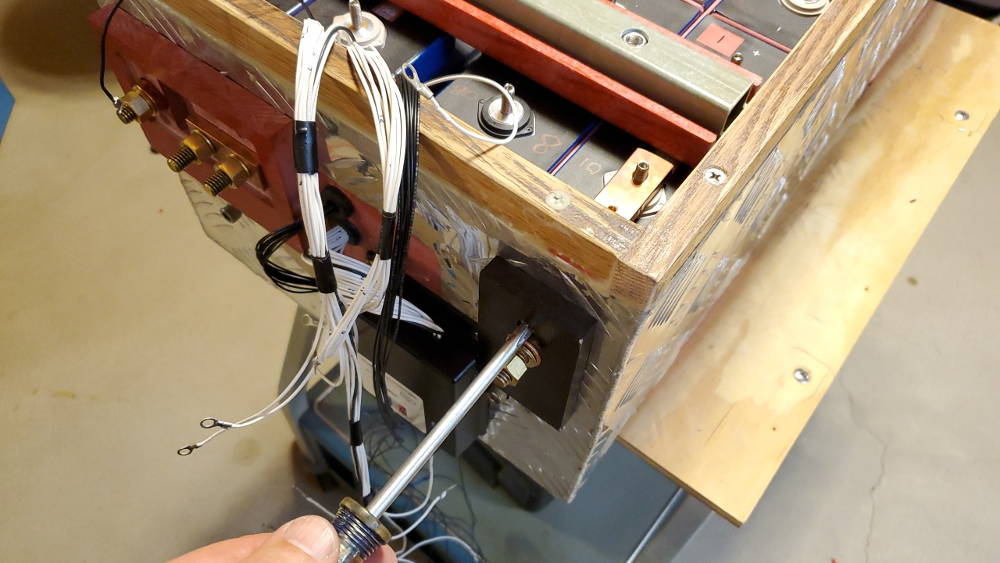 My BMS failed after 5 years. It was a Dylitium Design from Thunderstruck Motors and managed charging by controlling the charger via can bus. It did not control input/output of the battery directly. This has the advantage of eliminating the power controlling transistors in the current path which means the battery can still work if the BMS has failed. But it also means you have to use the charger that the BMS can talk to by can bus and you can't use any old generic charger of the correct voltage.
|
|
CONTROLLER PROGRAMMING AND INDICATORS The Sevcon controller has lots of capabilities that can be programmed into it. Thunderstruck did a basic programming to set it up for the particular motor and battery I have. There are additional programming features I would like to add.
Multi-stage Cooling
Indicator Lights
Shaft Parking Orientation |
|
PROPELLER 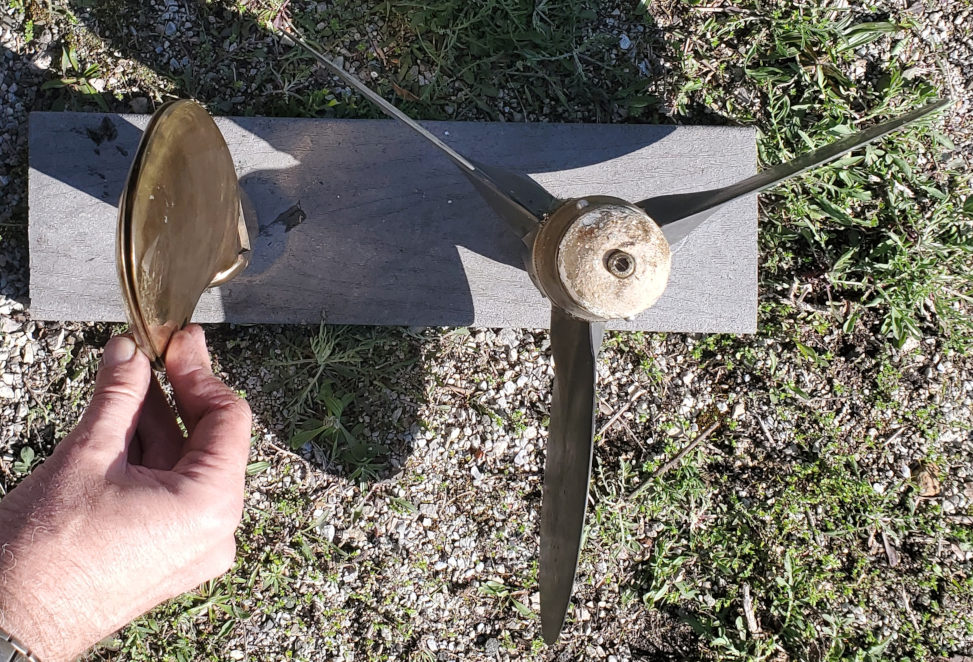
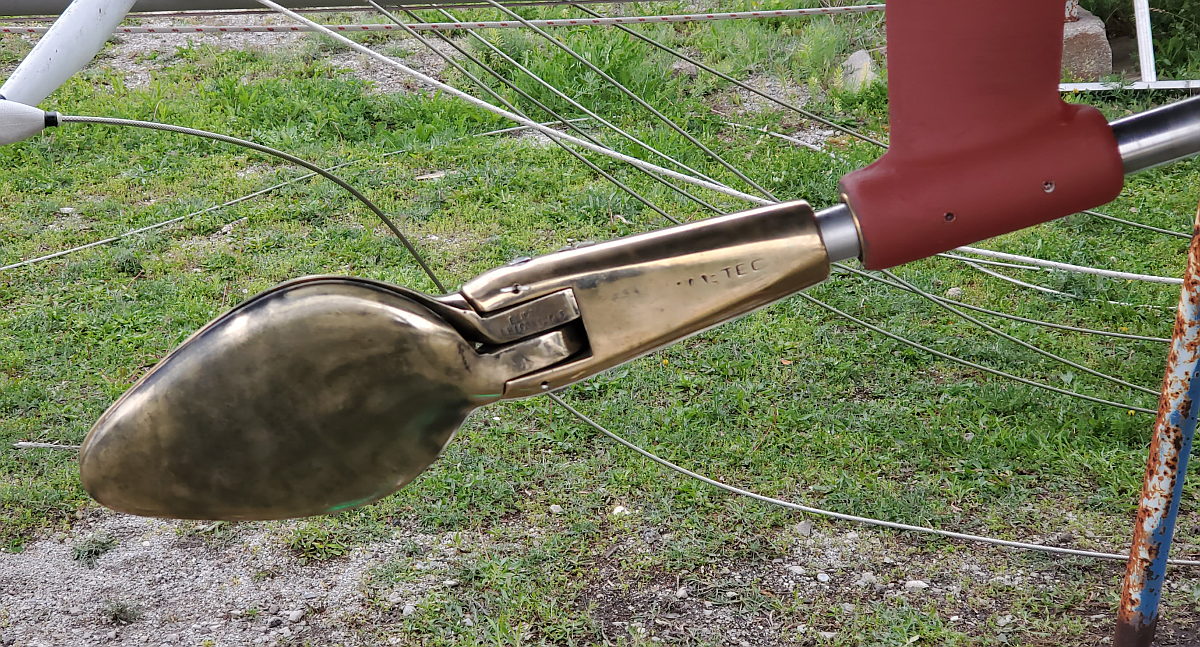
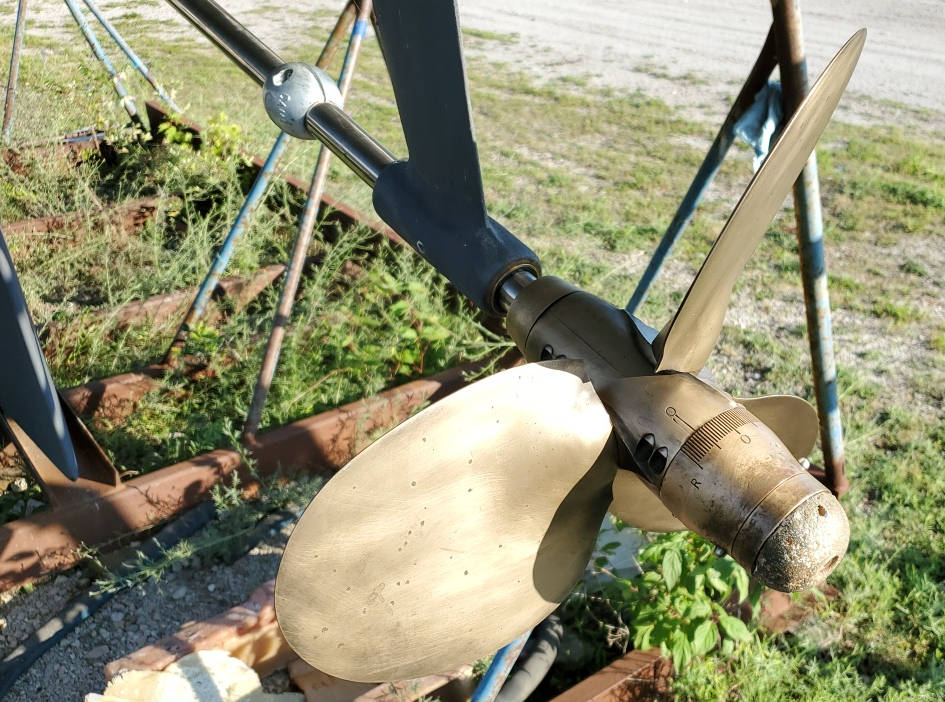 I switched from my 3-blade feathering prop to a folding Martec prop which has a bit less drag but also a bit less performance, especially in reverse. I gave up some motoring performance and I can't do regen but that never produced a lot of charging anyway so it was a fair trade for the way I use the boat. I can switch back for more serious cruising.
The folding prop has a different pitch and needs to turn faster. I changed the reduction gear from 3:1 to 2.7:1 by changing the drive pulley on the motor and the toothed belt. I had planned for this in the original design in case I needed further tweaking to get the prop match right. Cost was about $50 total. With the same 3:1 ratio the folding prop maxed out at about 6.1 knots at full power and drew about 5kW. The better matched 3 blade feathering prop topped out at a bit better than 7 knots (clean bottom) at 11kW. What's interesting is that the folding prop with the 3:1 reduction at 6 knots took the same power (5kW) as the 3 blade prop making the same speed. That makes sense because that's how much power it takes to move the boat at 6 kts regardless of how it's getting to the water. There is efficiency to gain or loose with a prop switch but to get the boat to go a given speed you need a given amount of thrust and while that will take different RPM with different props it still takes the same amount of power. The folding prop is 2 blade which is less efficient than 3 blades for the feathering prop but the blades are flat on the feathering prop which is less efficient than the curved blades on the folding prop. But the drag is lower when sailing with the folding prop. But the folding prop starts to fold from the motion of the boat when you go below about 3 kts. The feathering prop was happy at any RPM and speed down to 0.5 knots. |
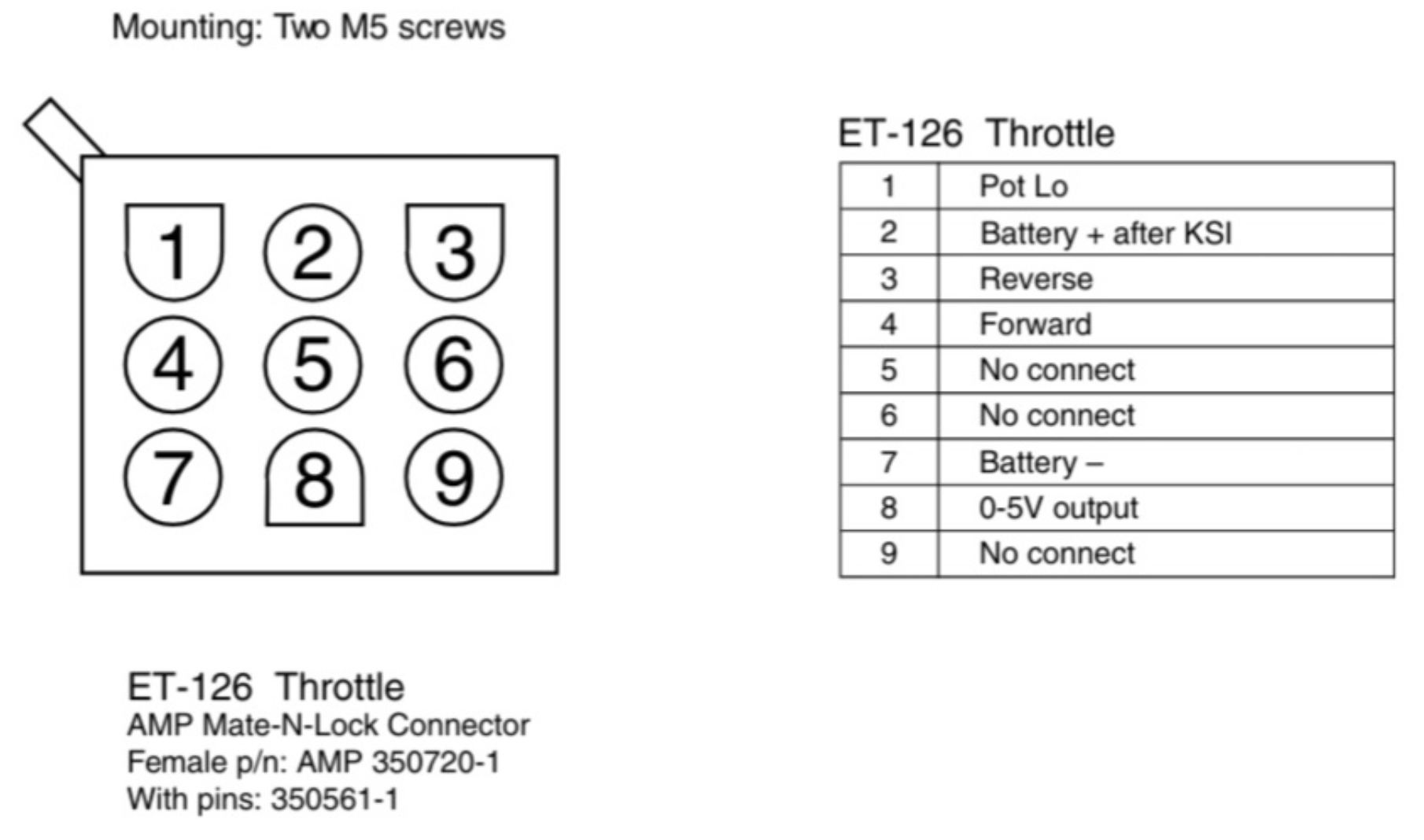
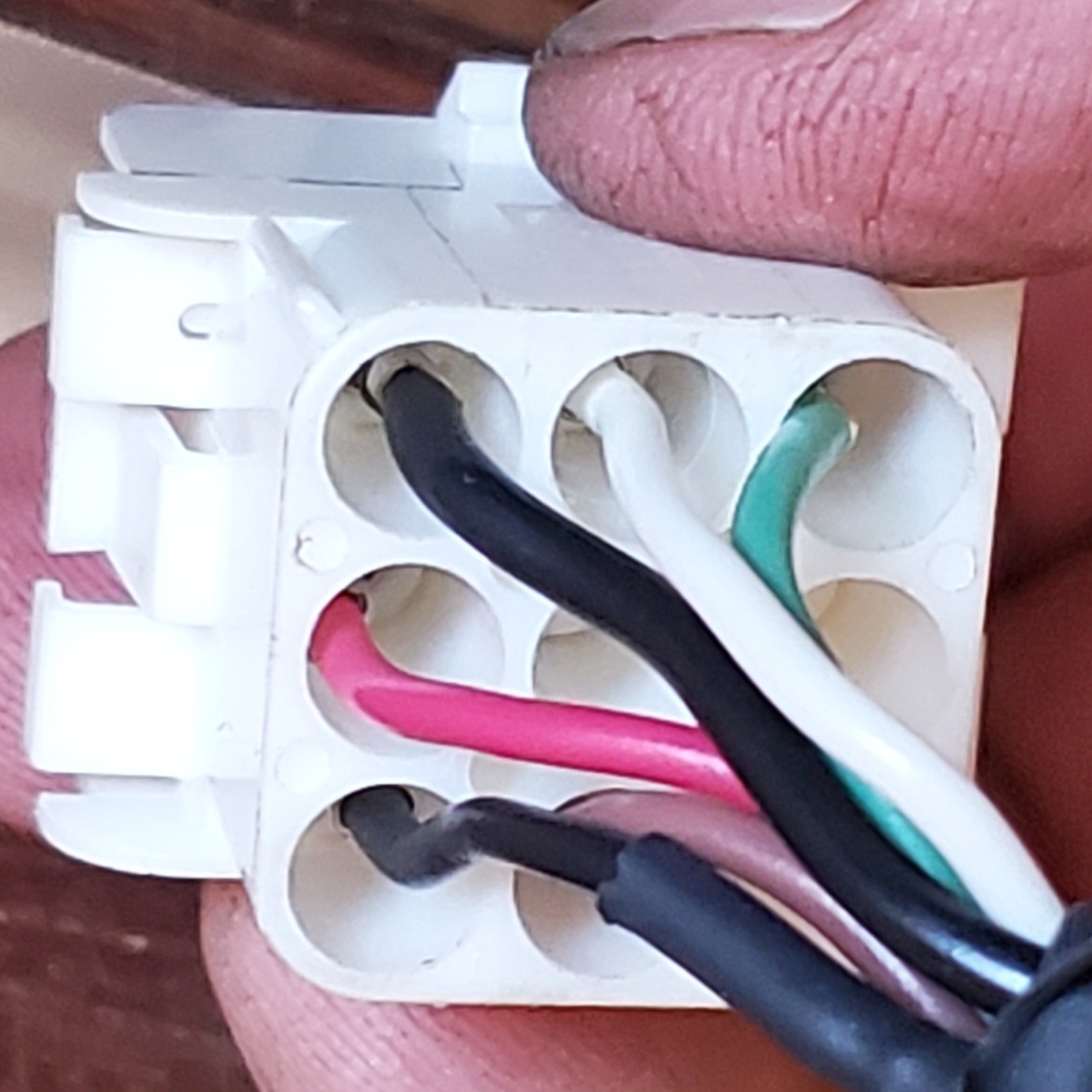 The new folding prop is left handed. I had the feathering prop setup for right handed. To swap the rotation of the motor I had to swap two wires (3 & 4) on the throttle. Very simple with the directions from Thunderstruck Motors.
|
|
DRIVE UNIT CONFIGURATION 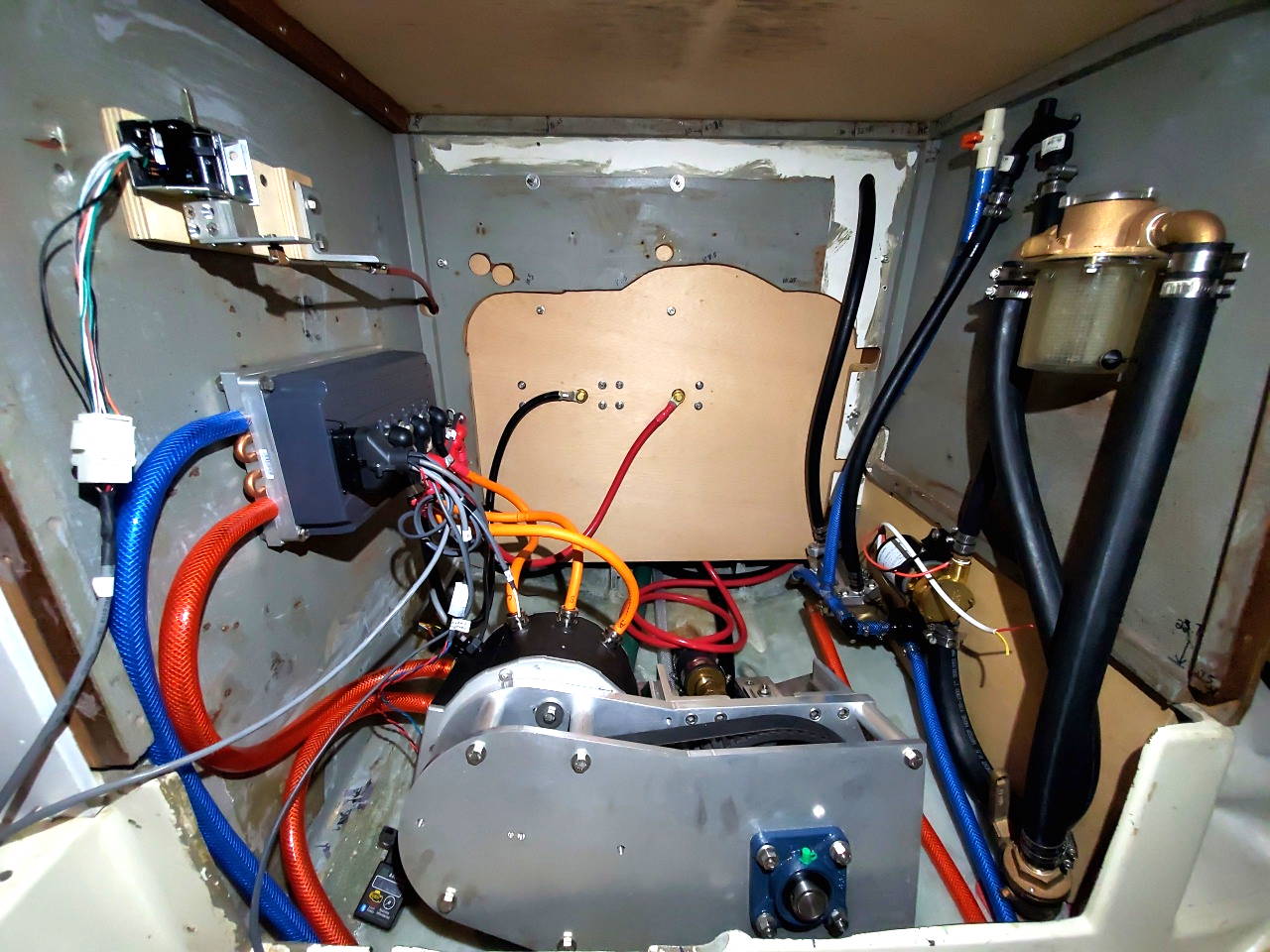
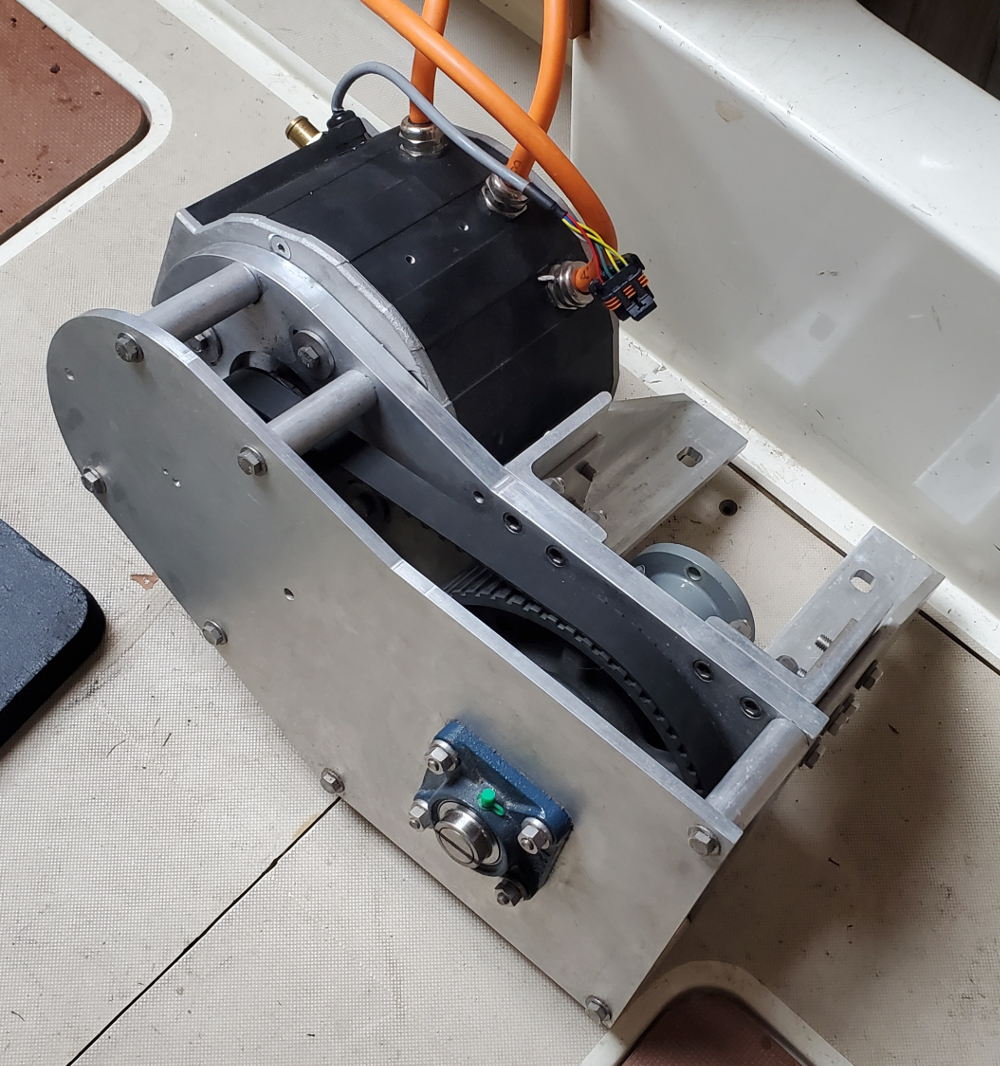 The motor is mounted to the side on my drive assembly. I did this to leave a larger space above for the battery or for a genset. It also alows excellent access to the prop shaft coupler and the stuffing box. The configuration is very robust but I'm sure there is some deflection from having the motor to the side. Some rotational relative to the shaft and some parallel. Having it above the prop shaft might limit the deflection to one direction? That might make for easier alignment and lower vibration. But it would also probably require some additional support for the weight of the motor. Maybe a strut on the back that connects to the frame where it sits on the beds. If I were designing this now I would explore making it more balanced where it meets the prop shaft for easier alignment. With the motor over the shaft and the controller mounted on the aft bulkhead of the space there could be a fairly large space to starboard of the motor for a galley storage locker. But it would make access to the coupler and stuffing box more difficult.
|
|
DRIVE MOUNT ALIGNMENT ADJUSTERS My drive unit is adjustable for alignment with the prop shaft. The yaw is adjusted by loosening the bolts that hold the unit to the beds and manually re-positioning the drive unit. Pitch and height are adjusted by loosening the bolts on the angle flanges that hold the motor plate to the flanges that attach to the beds. It all works but with a little more thought I could have added a way to tweak the pitch and height by turning a screw. That would be easier than trying to support the weight of the assembly while setting the alignment. |
|
DRIVE CONTROL LEVER 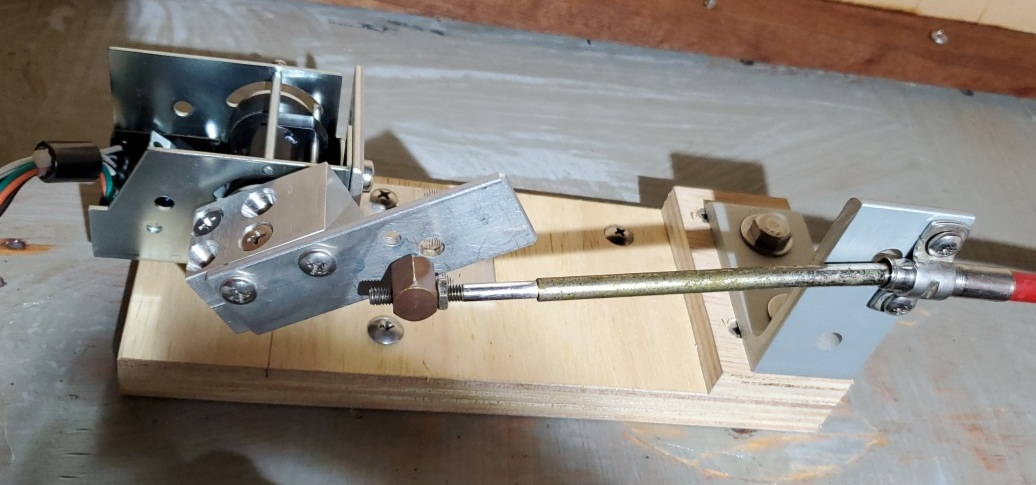 The throttle for the controller is a fairly small unit and not not so big as you perceive it should be to control 6 tons of boat. Originally I had it connected via cable to the original diesel motor control on the steering pedestal. Last year I had a failure in my system (bad idler pulley) and removed the wheel steering and installed a tiller. The Pearson 10M came either way and it steers very nicely with a tiller though there are some ergonomic trade-offs. After the switch I was muddling through the season with the controller on a small bit of plywood at the end of the wire. I would pull it out on deck and operate it directly. I need to come up with a permanent system. I am thinking of fabricating a knob control on the face of the forward end of the cockpit. Something that would not be prone to snagging lines.
|
|
BELT ENCLOSURE 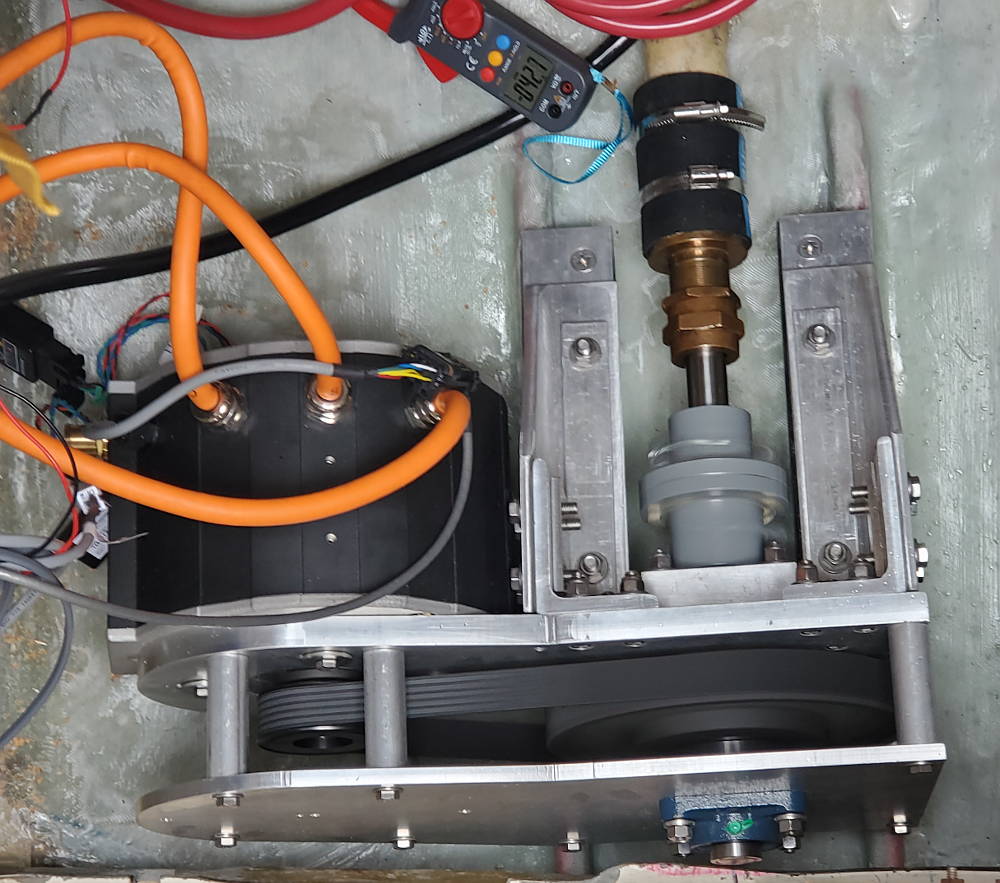 The drive unit I fabricated has an open frame. The toothed belt is the noisiest part of the system and I should have made side cover panels to fully enclose the belt. I plan to add these over the winter off-season.
|
|
GENSET CONFIGURATION PLAN 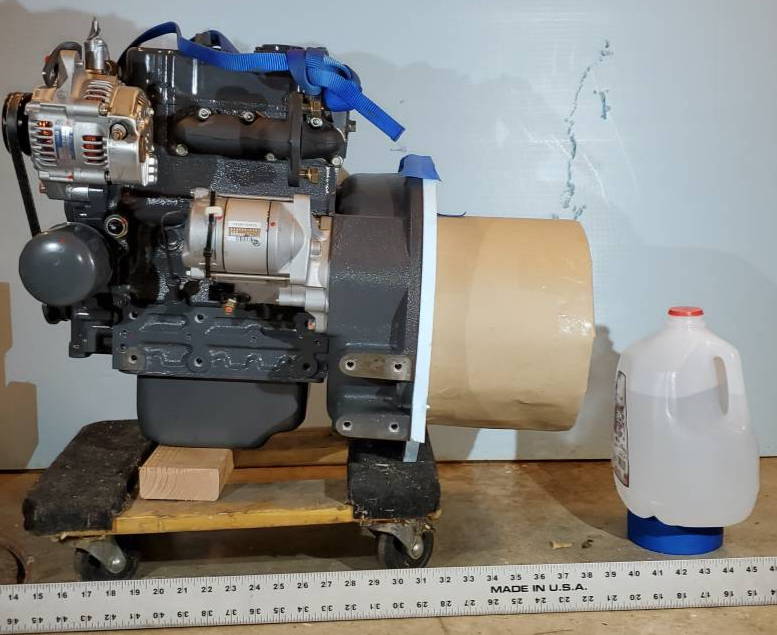 I had originally planned for a gen-set based on the same ME-1616 motor used as a generator on a 3 cylinder Kuboto diesel. It would have been 12kW capacity. After living with the electric drive for several seasons I think this is much more capacity than I need. To maintain 6 knots continuous takes about 5kW. So a generator of 6 or 8 kW would probably be enough.
For the use I currently make of the boat I don't need the genset. I could use some solar to keep the battery charged. |